

Velvet Shank Broth + Lacto Ferment Recipe
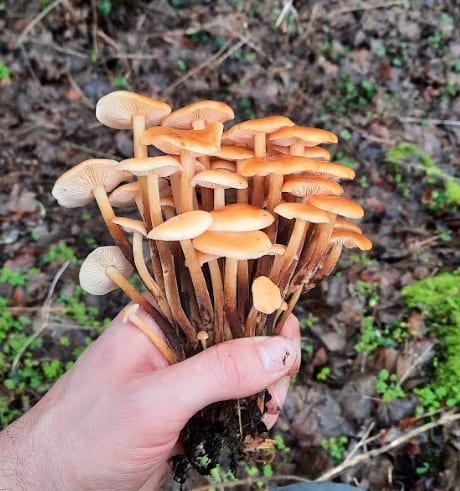
This recipe follows a series of experiments I have performed with Velvet Shank mushrooms. You will learn to make a tasty mushroom broth, from there, you will also learn how to make a lacto fermented chilli/Mushroom paste, a fermented broth, and how to potentially grow your own Velvet Shanks. I promise this will actually be very easy!
Previous years I haven’t found a single Velvet Shank, or so I thought, having no way to distinguish them from Honey Fungus or the Funeral Bell. It is quite possible that in fact I have encountered Shanks before and simply been unable to identify them. I suggest you familiarise yourself with our identification guide and take some spore prints to be absolutely certain, before cooking with these mushrooms.
These bunches of extremely aesthetic caramel caps, often flourishing from a single point, appear in the dead of winter when not much else is growing, which is a positive sign that what you have encountered are indeed Velvet Shanks, and not some other look-alike. It may be coincidence, but the Shanks I have encountered have always been found on very icy days, leading me to believe that they truly favour the coldest of weathers. Unlike most mushrooms which would be immediately ruined by a hard frost, our friend the Shank defrosts and continues to look perky for many days afterwards. This is great news for the forager, as defrosted mushroom sludge can only be relegated to the most desperate of soup pots, risking the emergence of maggots and potential bouts of food poisoning; Velvet Shanks pose far less of a risk in this area.
Nature, in all Her wisdom, knows what to provide and when. Velvet Shanks emerge from rotting treestumps and dead branches in hedgerows at a similar time to Turkeytail, a mushroom building a strong reputation as an immune tonic, just in time for cold and flu season. So too, does the Velvet Shank possess the qualities of an effective immune tonic, with the added bonus of edibility (instead of having to turn it into a tea/tincture) and excellent flavour. Scientific studies into Velvet Shanks (you are better off googling studies about Enoki, which is a close relative of the Velvet Shank, and is sometimes said to be the same mushroom just grown under different conditions) say that these mushrooms contain antioxidants, anti-cancer and immune regulatory chemicals (source). The anti cancer properties of this family of mushroom were first investigated after a researcher in Japan noticed that a particular village had far lower cancer rates than the general population; he eventually narrowed the statistics down to a community of mushroom farmers who had incorporated Enoki into their everyday diet (source).
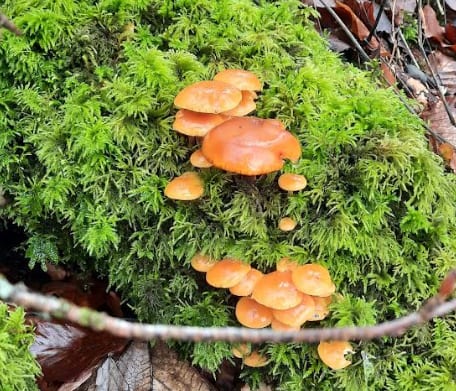
The winter of 2024/2025 has been prime Shank season for me, I have found them on three separate occasions in three separate parts of the country. The first time they presented themselves to me, I fried the life out of them with garlic, white wine, olive oil and salt. This is my go-to infallible recipe for preparing mushrooms to eat, it works with almost all species that can end up in a frying pan. However for my Shanks, this felt like a waste. They shrunk down to almost nothing and I could barely taste them alongside the overpowering ingredients in my meal. Something had to change, I needed to lock in all the goodness from the mushrooms and ensure that their flavour was the star of the show. Therefore, the logical conclusion was to create a broth, something I had never bothered to do with a mushroom before.
Recipe
Equipment
- Large pot or slow-cooker
- Salad spinner or colander (optional)
Ingredients
- A large bunch (or two) of Velvet Shanks
- Thumb sized piece of ginger
- Two sprigs of rosemary
- Three cloves of garlic
- Heaped teaspoon of chilli flakes
- Heaped teaspoon of rock/sea salt
- As much water as you would like broth (I used about 2 litres which reduced down)
Washing / collecting spore water
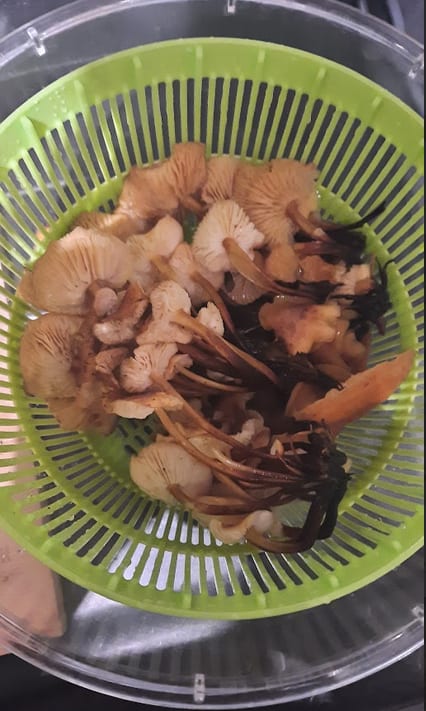
Depending on where you foraged your mushrooms from, they may be more or less dirty and in need of a wash. If you foraged your Shanks from the depths of a pristine woodland, you can probably give them a little rinse to rid them of wood debris and call it a day. My large haul was a risky forage, I found them growing in a bush off the side of a London A-road. Having observed the rapidity with which Velvet Shanks appear from nothingness in winter, I estimated they had been there for no more than 3 or 4 days, reducing the amount of pollutant they had been exposed to. I usually avoid foraging anything in such environments, but I could not resist the size of the glistening flushes that nestled seductively in the hedgerow.
Like a stray dog lurching for a freshly dropped kebab on a city street, I dived into the hedge and collected the largest bunches I could identify, before swiftly walking through the awakening streets of a London suburb, hands full of brightly coloured mushrooms. With the looks some people gave me as I passed, it would be easy to assume I was indeed a stray dog eating a dropped kebab from the gutter. These are not the type of shanks you usually see in the hands of young men on the streets of the capital, so I’ll give them that.
More fool them, they know not the deliciousness that awaited my palette, the bioactive polysaccharides, FVE protein, and ribosome-inactivating protein ready to turn my immune system into a veritable Fort Knox against the common cold!
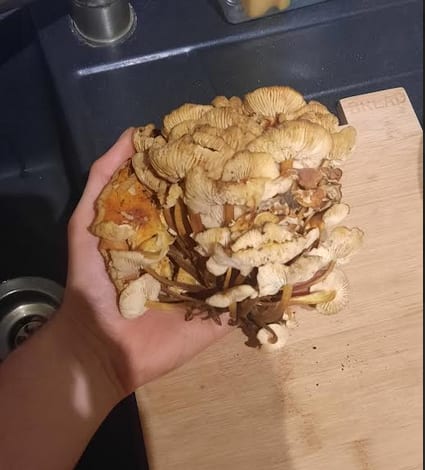
But I digress, let’s get back to the kitchen. The salad spinner in the recipe above was my attempt to thoroughly clean my mushrooms before they were entombed in my slow-cooker. Give the mushrooms a rinse first, then give them a spin in the salad spinner to remove dirt and water via centrifugal force. I noticed that the mushroom water had assumed a milky white hue - the same colour as the spore print I had taken to ensure these were indeed Velvet Shanks. Aha!
I set this water aside. In my garden I am running experiments on how to cultivate hardy mushrooms without sterile technique. I added this spore water to a pot of wood-chippings and sawdust which had previously failed to yield oyster mushrooms. Oysters and Shanks share similar diets of rotting wood. I may be lucky and end up with some Velvet Shanks growing in my garden by next winter! Please see Growing Gourmet and Medicinal Mushrooms by Paul Stamets for a far better guide on what to do with spores you find.
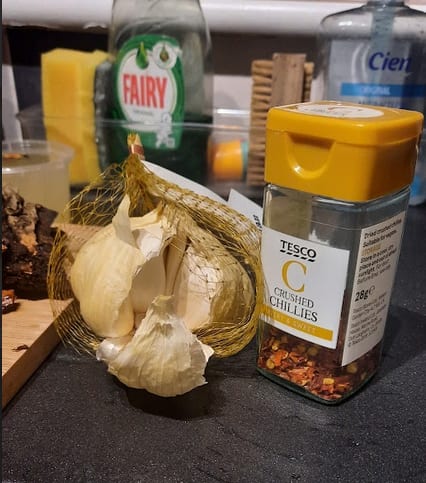
Combine ingredients
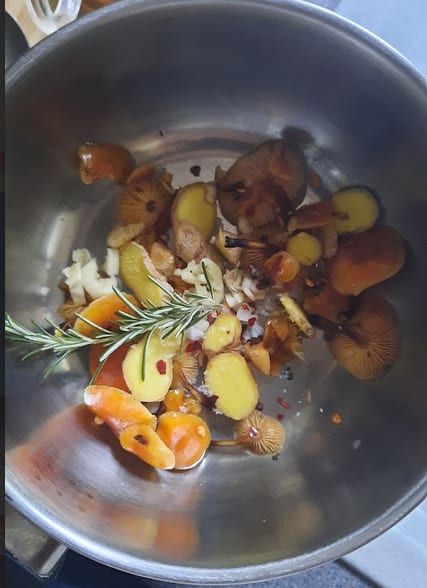
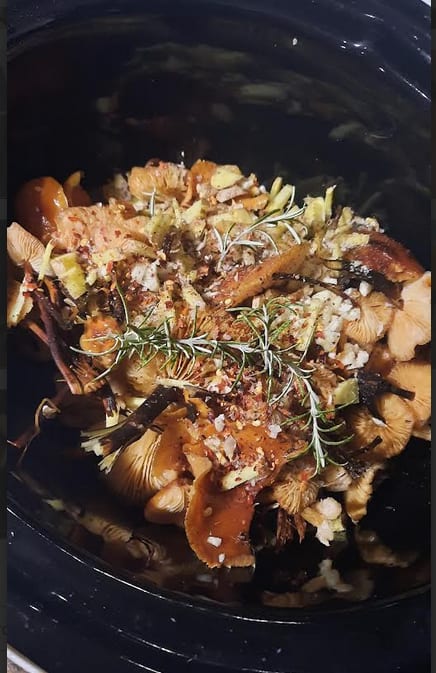
Making sure my Shanks were devoid of debris, I chopped off the woody parts attached to the stems and added them whole to the slow cooker.
Chop your garlic and ginger into chunks, then combine all ingredients in the list above and set your slow cooker to bubble away on auto overnight. In the morning, you will have a delicious - smelling mushroom infused broth.
The Shanks were still palatable to eat whole (for my tastes anyway, I do not enjoy overly slimy mushrooms and these had retained some firmness, however this is subjective) and the broth itself was also delicious. I broke a 19 hour fast with a bowl of this broth and it felt like the healthiest and most rewarding way to do so on a freezing cold winter’s day.
Keep the broth in a sealed container in the fridge and consume within a week, or freeze it and defrost when needed.
You may ask yourself, why is he still writing? What more is there to this recipe? All this rambling to stick some herbs and mushrooms in a slow cooker for 24hrs?
I decided that I wanted maximum HEALTH from my mushroom broth. How, I asked, is it possible to extract even more goodness out of this already wholesome and hearty myco-soup? The answer came to me thanks to a book I was given for Christmas, Wildcrafting Fermentation by Pascal Baudar.
I was to turn my mushroom broth into a lacto-ferment, to both extract even more HEALTH from the dish and to preserve it in a way that did not require freezing. The recipe from here onwards is more experimental than the simple broth above.
Please consult our guide on lacto-fermentation for the basics of how this procedure works. At its most basic, we add lactobacillus bacteria (found naturally on most vegetables, also in yoghurt) and salt, to make conditions favourable for the lactobacillus to take over our ingredients. The resulting mixture is one teaming with beneficial gut bacteria and compounds released by their eating of natural sugars. The generation of lactic acid by our little helpers, alongside the salt, will preserve the ferment for quite some time.
Part 2. Lacto fermented Velvet Shank recipe
Equipment
- Pint jars (screwtop or latched) - dependent on how much broth you have left
- Sieve
- Smaller jar
Ingredients
- The leftover Velvet Shank broth, mushrooms and all (just enough liquid to cover the solids is enough)
- 2 heaped teaspoons of rock/sea salt per jar
- Honey (1 tbsp per jar)
- Greek yoghurt - or any other lacto live culture
Optional:
- Miso paste
- Spent green tea leaves
We first isolate our fermenting bacteria to add to our jars. Place a scoop of yoghurt in a sieve and sit the sieve above your small jar. Wait 30mins and return to the jar, you should see a milky white liquid sitting at the bottom, this is your whey, which contains the cultures needed to kickstart the fermentation process, it is that simple to collect them!
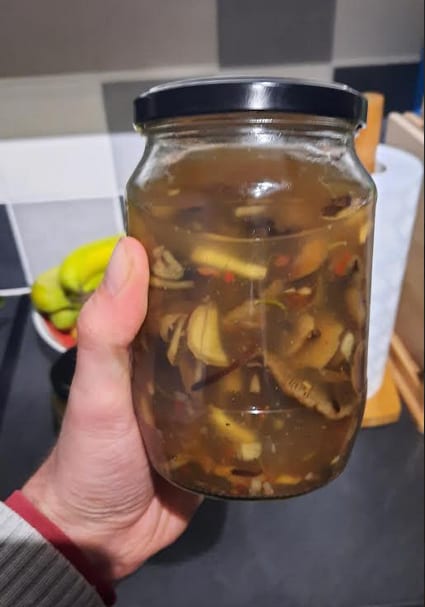
Next, add your mushroom broth to your jars, I had 2 pint jars ⅘ full with broth. Add a tbsp of honey to each jar, this is food for your lactobacillus, then add the 2 heaped tsp of salt to each jar. This should ensure a salinity favourable to the helpful bacteria without making the mix too salty. For more precise methods and measurements, I suggest you read Pascal’s fermentation book for a comprehensive guide.
Finally, when the mushroom broth is at room temperature, add your whey liquid to each jar, approx 1tsp per jar (more is good, I just didn’t have more liquid). Seal each jar and give them a good shake. Set aside at room temp and wait.
The next morning, give your jars another shake. I suggest doing this 2x a day to ensure any floating contents are coated with salt brine to prevent spoilage. You may start to see bubbles appearing in your mixture, the broth will start turning from clear to cloudy as fermentation begins.
Leave the mix for about a week, shaking 2x daily. If you detect gas build-up in the jars, burp them by twisting the lids open to relieve pressure. Pascal suggests that you leave mushrooms for only a few days, as they’ll become softer as the ferment progresses, but where they were already slow-cooked, I planned to turn them into a paste, meaning that we are not concerned about texture here.
After fermentation has slowed. Separate your jar contents into solids and liquids using a sieve, collect the broth in a bowl. The lacto-broth is something that can be consumed cold or heated and drunk like a soup. I’m not sure how nice either will be, I am yet to test this but am loath to waste such a nutritious liquid.
Add your solids to a blender, and blitz to turn into a paste. This is a mix of all the ingredients that went into your initial soup and should be a very tasty accompaniment to asian-style poke bowls, eaten with crackers or on bread. To a future batch I added miso paste and green tea leaves that had already been flushed with water. These added to the umami flavour.
PLEASE NOTE: If you encounter any specs of mould, green/white coloured floating globules, or smells that make you gag upon inhalation, please throw your ferment away and do not risk consumption. Your ferment has likely spoiled and will be full of unknown (possibly pathogenic) fungi and/or bacteria.
If this all seems a step too far for you, simply stop at the end of the broth instructions and you will end up with a very enjoyable meal. If you wish to step into the world of mad science and bubbling jars, then proceed with part 2. You will stand almost shoulder to shoulder with the ancestral living freaks that supplement their diets with raw organ meats, beware fermentation, it is a slippery slope into shirking common culinary convention!